Insights
The Best Sleeping Position for Neck Pain (Backed by Research)
You’ve tried stretching. You’ve tried heat packs. You’ve tried adjusting your desk monitor to eye level. Yet every morning, you wake up with that familiar, grinding stiffness in your neck that takes half the day to shake off.
Here’s the uncomfortable truth: no amount of daytime ergonomics can overcome eight hours of sleeping in a position that damages your cervical spine. Your sleeping position - and critically, the pillow that supports it - is the single biggest factor determining whether you wake up pain-free or in agony.
Ranking the Positions: Best to Worst
1. Back Sleeping (Supine) - The Gold Standard
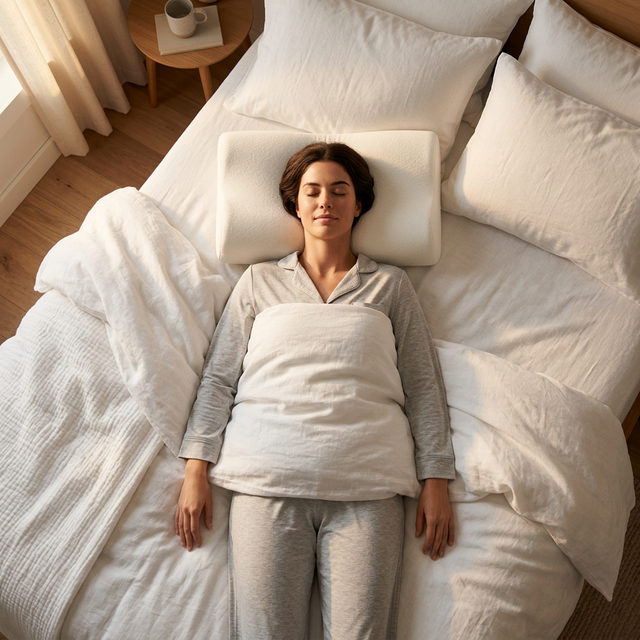
Sleeping on your back distributes weight evenly across the widest surface area of your body. Your head, neck, and spine can rest in a naturally neutral alignment without any rotational or lateral forces.
The Mayo Clinic recommends back sleeping for neck pain sufferers because it eliminates the asymmetric loading that side and stomach sleeping create. When executed correctly - with a pillow that cradles the natural lordotic curve of the neck - all of the cervical muscles can fully relax and recover during sleep.
The critical variable: Your pillow must be the right height. Too high, and your chin is pushed toward your chest, overstretching the posterior neck muscles. Too flat, and your head falls backward, compressing the facet joints. The ideal loft creates a gentle, neutral curve.
2. Side Sleeping - Good, with Conditions
Side sleeping is the most common position, and it can be perfectly healthy for the neck if the pillow provides adequate support. The challenge is that side sleeping creates a significant gap between your head and the mattress - the distance from your ear to the outside edge of your shoulder.
If your pillow is too flat, your head drops downward, bending your spine laterally. This puts uneven compression on the cervical discs and strains the muscles on one side of your neck. If you’re waking up with shoulder pain alongside your neck stiffness, your pillow is almost certainly too flat for your body type.
The critical variable: Side sleepers need a pillow with noticeably higher loft than back sleepers - typically 4 to 6 inches. The pillow must fill the entire shoulder-to-head gap without collapsing.
3. Stomach Sleeping - The Worst Position
There is no clinically acceptable way to sleep on your stomach without causing cervical stress. When prone, you must rotate your head 90 degrees to breathe. This forces the cervical vertebrae into extreme rotation for the entire night.
According to research indexed by PubMed, sustained cervical rotation during sleep is associated with increased neck pain, restricted morning range of motion, and long-term disc degeneration. The muscles on one side of your neck are shortened and compressed while the opposite side is maximally stretched - an asymmetry that causes chronic pain.
The fix: Transition to side sleeping using a body pillow for the sense of pressure and comfort that stomach sleepers crave, while keeping your neck in a neutral position.
Why Position Alone Isn’t Enough
Here’s what most sleep guides miss: the “best” sleeping position is only as good as the pillow supporting it. Even perfect back sleeping becomes harmful if your pillow has collapsed and lost its loft. Your neck muscles will still engage all night to stabilize an unsupported head.
The relationship between sleeping position and pillow height is inseparable. Getting the position right but the pillow wrong is like wearing the right running shoes but lacing them incorrectly - the foundation fails under pressure.
The Pillow That Adapts to Every Position
The Siestly Pillow is crafted with a gel-infused Active-Core memory foam that adapts to your head and neck contour, regardless of whether you’re a back sleeper or a side sleeper. The foam compresses precisely where it needs to - under the weight of your skull - while maintaining full loft under your neck, preserving that critical cervical curve.
For back sleepers, it cradles the lordotic curve. For side sleepers, it provides the height needed to keep the spine ruler-straight. For former stomach sleepers making the transition, it offers the plush comfort that makes staying on your side feel natural.
Stop letting your sleeping position fight against your pillow. Visit the Siestly Pillow page and give your cervical spine the nightly protection it desperately needs.
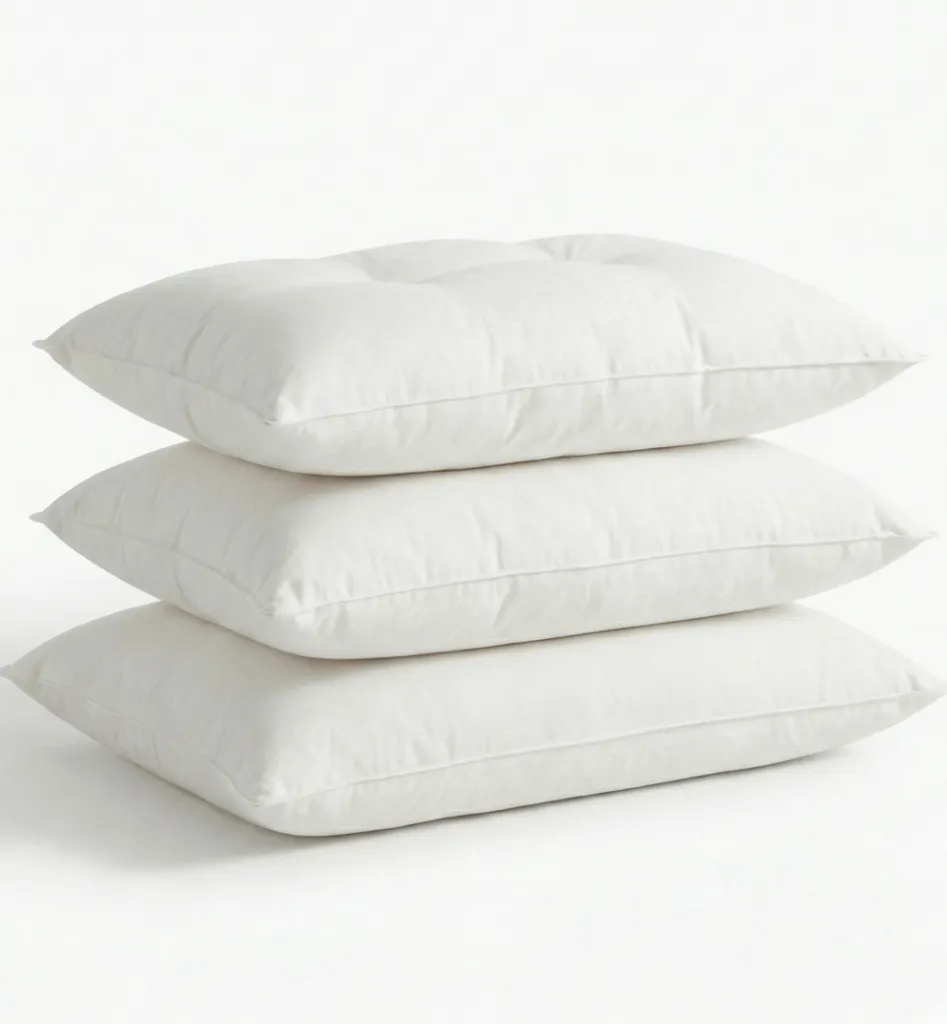
Experience True Alignment.
Say goodbye to morning neck pain and migraines. The Siestly pillow features a unique tufted design that cradles your head for perfect orthopedic support all night long.
Shop the Pillow